


Safety Nets in Construction, Sports and Home Safety.
Safety nets are most commonly used in construction projects which employ 500 workers or more as mandated by the Building and Other Construction Workers (Regulation of Employment and Conditions of Service) Act, 1996.
With that said, many high-rise & multi storey building projects do use safety nets. As they help them in multiple ways.
Construction safety nets are the safest and cost effective fall prevention system in the world. Made from HDPE or High-density polyethylene raw materials.
Construction safety netting system is also known as debris netting which can be installed both horizontally or vertically according to the requirements.
The best part about construction netting is that you can wrap up the whole construction site from bottom to top, horizontally or vertically according to requirements.
It works as a protection wall to prevent anything from falling without blocking the view.
Safety net installation at any building site requires professional expertise and technical knowledge.
Apart from this there are multiple use cases where safety nets prove to be useful for both commercial and home safety (or domestic use).
Let me explain the different types of safety nets and their use cases. Some may even prove to be beneficial for you.
-
Industrial Safety Nets, Construction Safety Nets / Building Safety Nets, Glass Safety Nets, Balcony Safety Nets, Duct Area Safety Net, Mall Safety Nets & Anti Bird Nets.


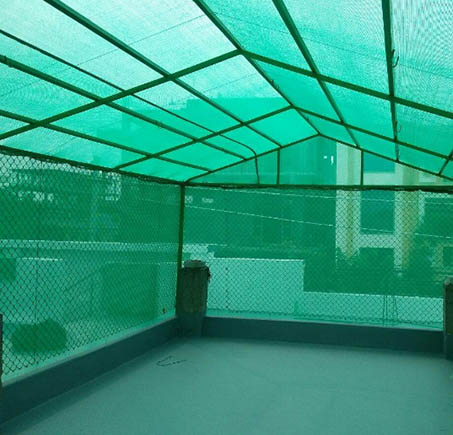
- Reduces the probability of fatal accidents due to people or objects falling.
- Provides protection to glass doors & windows. Also protects people from broken glass pieces, if a glass window shatters due to any reason. There by avoiding accidents.
- Prevents birds from littering your balconies.
- Construction materials (or debris) won’t fly around during high-rise constructions.
These safety nets usually cover, almost the entire building vertically especially on under construction buildings.
They are also equipped into individual flat balconies as they provide all the above mentioned benefits without restricting the natural light or air flow of the premises comparatively.


Commonly installed directly by an installer with not much additional design requirements.
These are used mostly by families and in settings where small children commonly use the stairs. This is usually installed on staircase railings and structures of similar sorts.
- This protects infants and small children who have a high risk of facing such a situation.

Mosquito nets are pretty self-explanatory, they prevent mosquitos from entering your home.
If you live in an area with the same problem. An installer will be able to setup mosquito nets in all possible areas of entry.


- Limits bird littering.
- Provides a certain level of security and privacy to the parking lot.
- Protects vehicles from things falling on top of it.
These nets can be considered as a low cost alternative to using plastic, aluminum or steel roofing sheets.

- Protection from sunlight and other climate changes.
- Protection from harmful animals and insects.
Agricultural safety nets are widely used in domestic and commercial gardens or plant nurseries. They are also popular among farmers who need netting setups for various purposes.
From poultry to horticulture. Below mentioned coconut tree safety net can also be considered a subset of agricultural safety nets.

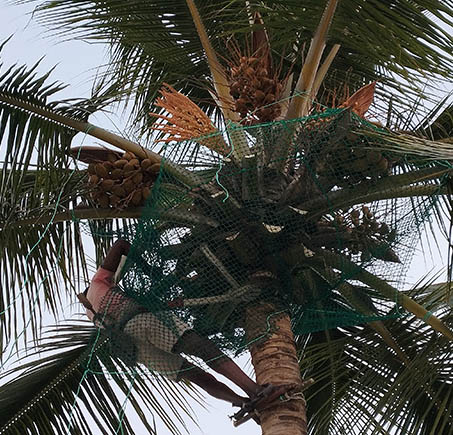
- Stops coconuts and other items from falling on to someone or some vehicle.
- Can help control theft or loss of coconuts.
Coconut tree safety nets are usually setup close to the top of the tree hence controlling the fall of objects.

- Stops ball from flying off court.
- Prevents birds and other objects from entering into the turf.
Commonly seen on football and cricket turfs.
These turfs usually prefer such nets as it does not restrict the flow of air and light.
With all that said there are multiple factors you should consider before choosing the kind of net for your specific purpose.
Such as,
- The possible force of the impact.
- Total width of the net.
- The minimum-distance of the spot on net at which object impacted.
- The edge of net (nearest-edge).
- Materials used to make the ropes of the net (such as an iron rod grid will not work as good as flexible and extensible ropes).
- The tension or stretch used to make the net (stored in the ropes).
- The net’s height from hard ground.
- The mesh hole size so that falling object/people/part of it could pass through the holes.
We always recommend you seek professional help when it comes to projects related to yours or someone else’s safety.
Call now for professional safety net installation services.
In short safety nets can be summed up as a low-cost alternative to having a physical block aid such as a concrete wall or fall arrest setup for safety and security purposes.
Visual inspections must be carried out regularly. If a net does not pass a visual inspection, do not use it.
Read: How you can evaluate the quality of the safety net you just installed?









Leave A Comment